Beyond the Beaches: Embracing Bali’s Spiritual Heartbeat
Most people picture Bali and see sun-drenched beaches and infinity pools. While those exist, they are merely the beautiful wrapping paper on a much more profound gift. Bali’s true identity is the “Island of the Gods,” a place where spirituality is not a scheduled activity but is woven into the very air you breathe. It’s in the scent of incense drifting from a doorway and the intricate offerings placed on a sidewalk.
Experiencing this as a group transforms a simple holiday into a shared pilgrimage. Imagine the conversations that spark after witnessing a village ceremony together or the quiet understanding that settles over your friends while learning to craft an offering. These are the moments that build connections far deeper than a shared sunset cocktail. They become collective memories, stories you will retell for years.
This first time Bali travel guide is designed to help your group access that deeper layer. We will explore the core philosophies that shape Balinese life, cover the practical etiquette needed for respectful interactions, and highlight key cultural landmarks with logistics specifically for groups. This journey is not about passive observation. It is an invitation to engage with an open heart and mind, allowing the island’s unique spirit to leave a permanent mark on you all.
Think of this guide as one of many in-depth explorations we offer, similar to our other city guides that help travelers connect with a location’s true character. The goal is to move beyond the surface and find the authentic pulse of a place. Are you ready to discover the real Bali together?
The Foundations of Balinese Life and Spirituality
To truly appreciate Bali, you must first understand the invisible architecture that supports its culture. What you see on the surface, from the vibrant ceremonies to the community structure, is all rooted in a few core beliefs. Grasping these ideas will change your perspective from that of a tourist to an informed guest, enriching every observation your group makes.
Tri Hita Karana: The Philosophy of Harmony
The entire Balinese worldview rests on Tri Hita Karana, a philosophy centered on achieving harmony in three key relationships: harmony with the divine (Parahyangan), harmony among people (Pawongan), and harmony with nature (Palemahan). This is not an abstract concept. It is a daily practice. You see it in the elaborate temple ceremonies honoring the gods, the strong community bonds of the Banjar, and the deep respect for the natural world, from sacred banyan trees to the rice paddies that sustain life. For your group, understanding this concept provides a framework for everything you will witness.
Canang Sari: The Art of Daily Offerings
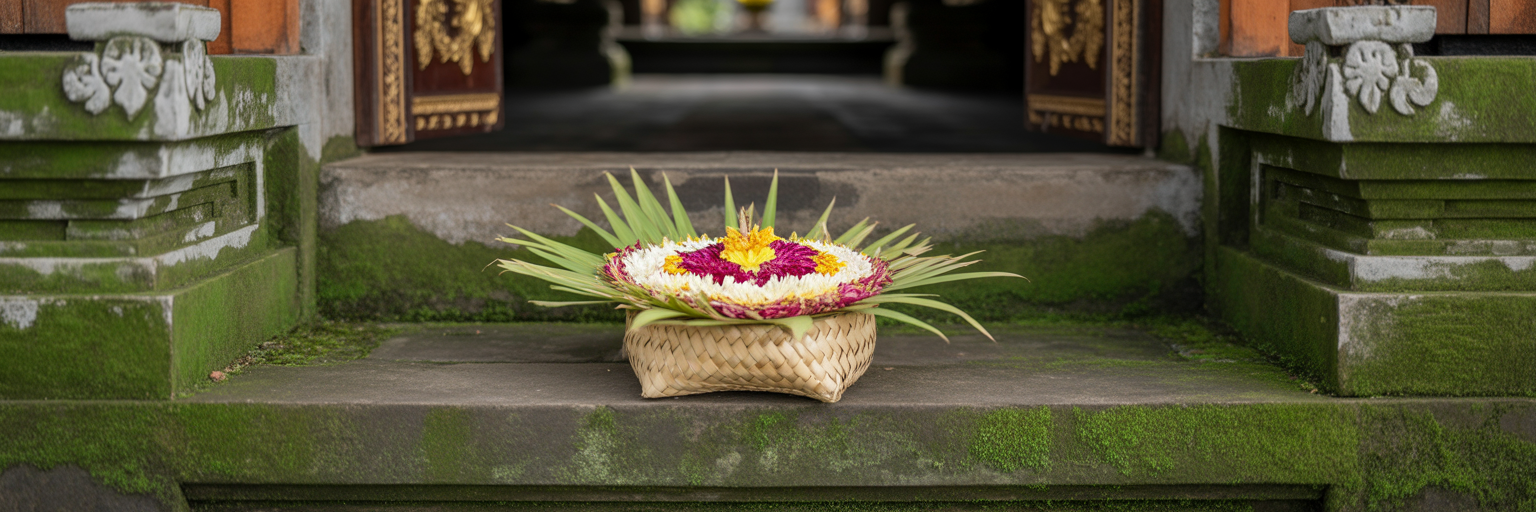
You will see them everywhere: small, hand-woven baskets of palm leaf filled with flowers, rice, and incense. These are Canang Sari, daily offerings made to express gratitude and maintain balance. Each element is symbolic, from the color of the flowers representing different gods to the burning incense carrying the prayer to the heavens. They are a constant, tangible reminder of Tri Hita Karana in action. The most crucial piece of practical advice for any visitor is to never step on these offerings. Walking around them is a simple yet profound sign of respect. Point them out to your group so everyone is aware of their significance.
The Banjar: The Heart of the Community
Balinese society is deeply communal, and the Banjar is its beating heart. It is more than just a village council. It is the social, religious, and administrative hub for a local neighborhood. The Banjar organizes temple festivals, manages community resources, and even mediates disputes. Membership is a cornerstone of family life, and this collective structure is why you will see entire communities working together to prepare for a ceremony. When you see a group of men practicing for a Gamelan performance or women weaving offerings together, you are witnessing the Banjar in action. It is a powerful display of the “harmony among people” principle.
Pura: More Than Just Temples
Balinese temples, or Pura, are not silent monuments for tourists. They are active, living centers of community life. Every village is required to have at least three main temples, each serving a different purpose under Tri Hita Karana. The Pura Desa is the temple for official village ceremonies, the Pura Puseh honors the village founders, and the Pura Dalem, or temple of the dead, is associated with spirits and the cycle of life and death. Recognizing that these temples are integral to daily spiritual practice, not just photo opportunities, is the first step toward respectful exploration.
Essential Etiquette for Respectful Cultural Immersion
Navigating a new culture can feel like learning a new language, and in Bali, small gestures of respect speak volumes. For a group, having a shared understanding of local customs prevents unintentional missteps and opens the door to more meaningful interactions. Here are the essential rules of Balinese temple etiquette for tourists and general social conduct.
- Dress Appropriately, Especially at Temples: Modesty is a form of respect. When visiting any temple (Pura), both men and women are required to cover their shoulders and knees. This means wearing a sarong (a cloth wrapped around the waist) and a sash (selendang). Most major temples offer rentals at the entrance for a small fee, which is often the easiest option for a group. If you plan on visiting many temples, buying your own in a local market can be a fun group activity and a great souvenir.
- Mind Your Body Language in Sacred Spaces: Balinese culture has specific rules about physical conduct in holy places. The head is considered sacred, so never touch anyone’s head. Conversely, feet are considered impure, so do not point your feet at altars, priests, or sacred objects. When sitting, try to sit with your feet tucked underneath you. It is also considered disrespectful to stand at a higher elevation than a priest (Ida Pedanda) performing a ceremony.
- Observe Ceremonies with Quiet Respect: Your group may be lucky enough to witness a local ceremony. This is a privilege, not a performance. Maintain a respectful distance, keep conversations to a minimum, and move with quiet intention. The biggest challenge for a group is managing collective noise. Agree beforehand to observe in silence. Your quiet presence will be appreciated far more than you know.
- Use Your Right Hand for Interactions: In Bali, as in many parts of Asia, the left hand is considered unclean. Always use your right hand to give or receive anything, whether it is money, a business card, or a gift. If you must use your left, you can touch your right elbow with your left hand as a sign of respect. It’s a small detail that shows you have taken the time to understand local customs.
- Embrace ‘Jam Karet’ (Rubber Time): The Western obsession with punctuality does not always translate. The Balinese concept of ‘jam karet’, or rubber time, reflects a more fluid approach to schedules. While your driver or guide will likely be on time for you, be prepared for things to run on a more relaxed schedule, especially concerning ceremonies or community events. Patience is a virtue your group should practice together.
- Practice Mindful Photography: We all want to capture the beauty of Bali, but not at the expense of someone’s dignity or spiritual moment. Always ask for permission before taking a close-up photo of a person. During a ceremony, be discreet and never use a flash. A good rule of thumb is to ask yourself: “Is my photo disrupting this moment?” If the answer is yes, put the camera down and just be present.
| Situation | Do | Don’t |
|---|---|---|
| Visiting a Temple | Wear a sarong and sash, covering shoulders and knees. | Point your feet at sacred objects or people praying. |
| Interacting with Locals | Smile and use your right hand to give or receive items. | Touch someone’s head, which is considered sacred. |
| Observing a Ceremony | Maintain a respectful distance and observe quietly. | Use flash photography or walk in front of the priest. |
| Encountering Offerings | Walk around the ‘Canang Sari’ offerings on the ground. | Step over or disturb the offerings. |
| General Communication | Use polite greetings like ‘Om Swastiastu’. | Raise your voice or display anger publicly. |
Navigating Bali’s Most Significant Cultural Landmarks as a Group
With a foundational understanding of Balinese culture, your group is ready to explore its most iconic sites. A well-planned Bali group travel itinerary should include these landmarks, but visiting them requires more than just showing up. Here is how to approach four of Bali’s most important temples with group logistics in mind, ensuring a smooth and meaningful experience for everyone.
Uluwatu Temple: Sunset Views and the Kecak Dance
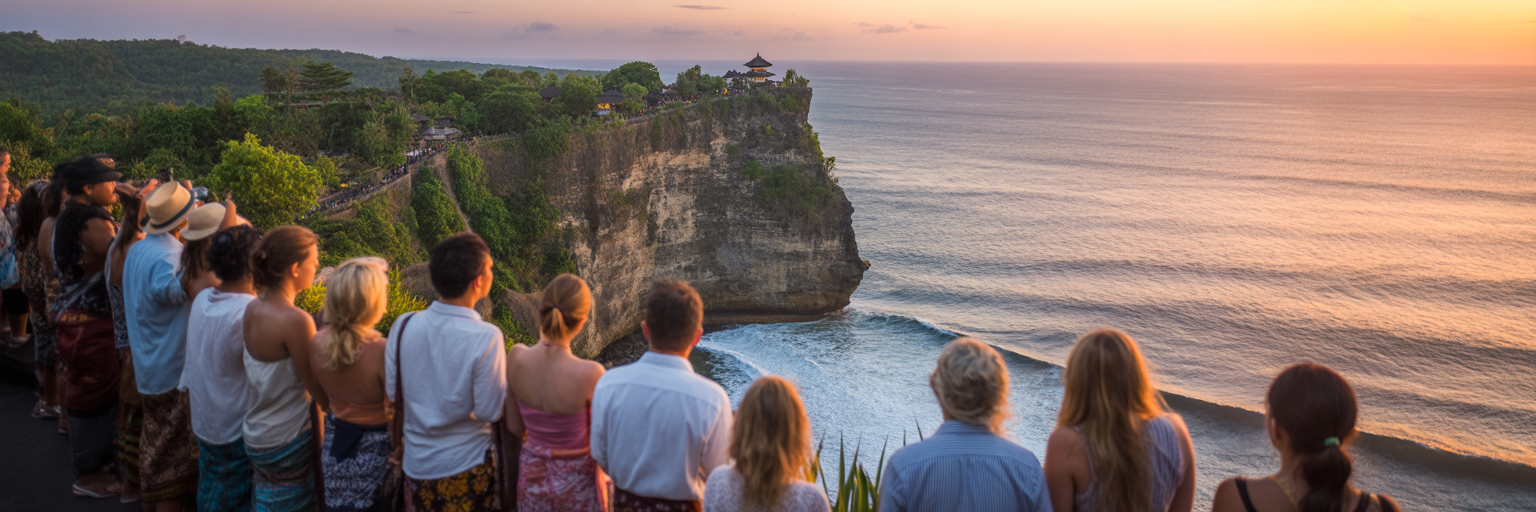
Perched dramatically on a cliff edge overlooking the Indian Ocean, Pura Luhur Uluwatu is one of Bali’s six key spiritual pillars. Its setting is breathtaking, especially at sunset. The main event for most visitors is the nightly Kecak fire dance, an enchanting performance telling a story from the Ramayana epic. For a group, it is essential to book tickets for the dance well in advance, especially during peak season, to ensure you can all sit together. Also, be mindful of the resident monkeys. They are known for snatching sunglasses, hats, and phones. Advise your group to secure all loose belongings before entering.
Tanah Lot Temple: The Iconic Sea Temple
Tanah Lot is the image many people have of a Balinese temple: a stunning silhouette on a rocky outcrop against a vibrant sunset. Because of its fame, it gets incredibly crowded. For a group, the key is managing expectations and logistics. The temple itself is only accessible during low tide, and the terrain is uneven and can be slippery. Designate a clear meeting point and time for your group to reconvene. Instead of everyone fighting for the same sunset photo, encourage members to explore different vantage points. Sometimes the best views are away from the main crowds.
Tirta Empul: The Holy Springs of Purification
This temple complex is famous for its holy spring water, where Balinese Hindus go for ritual purification in a ceremony known as melukat. For visitors, participating in this ritual can be a profound experience, but it must be done with the utmost respect. This is not a swimming pool. For a group, it is highly recommended to hire a local guide. A guide can explain the meaning behind each step of the ritual, from the initial offering to the proper sequence for bathing in the fountains. This ensures your group participates respectfully and gains a genuine understanding of the ceremony, rather than just getting wet.
Besakih Temple: The Mother Temple Complex
Located on the slopes of Mount Agung, Besakih is known as the “Mother Temple” of Bali. It is not a single temple but a vast complex of at least 86 temples. Its scale can be overwhelming, and unfortunately, it has a reputation for aggressive touts. This is where traveling as a group with a plan is a huge advantage. Insist on hiring an official guide from the ticket office. A guide will not only navigate the sprawling grounds and explain the significance of the different temples but will also shield your group from unofficial guides and donation requests. This turns a potentially stressful visit into a fascinating journey through the heart of Balinese Hinduism. Planning a trip that includes these significant landmarks is a cornerstone of truly experiencing the island, a principle that guides us at When In Your City as we help travelers build comprehensive journeys.
Immersive Experiences Beyond the Temples
While temples are the spiritual anchors of Bali, the island’s culture is also expressed through its art, food, and community life. Engaging in hands-on activities allows your group to connect with these traditions on a personal level. These shared experiences are often the most memorable parts of a trip and are perfect for answering the question of what to do in Bali with family or friends.
- Participate in a Balinese Cooking Class: Food is a universal language, and a cooking class is a fantastic way for a group to bond. You will learn about the exotic herbs and spices that form the foundation of Balinese cuisine, from galangal to turmeric. The collaborative process of preparing a meal together, from grinding spices for a ‘bumbu’ paste to wrapping fish in banana leaves, is both fun and educational. Most classes can easily accommodate different dietary needs and end with a delicious feast that you all prepared.
- Attend a Traditional Dance Performance: Beyond the famous Kecak dance at Uluwatu, seek out other performances like the Barong or Legong dance. These are not just spectacles. They are vibrant forms of storytelling. As cultural guides like BlazeTrip note, these performances often depict stories from Hindu epics and are vital expressions of Bali’s spiritual heritage. Watching the intricate movements and expressive masks together can spark fascinating conversations about mythology and art.
- Create Your Own Souvenir in a Craft Workshop: Instead of just buying souvenirs, why not make them? Bali is home to generations of skilled artisans. A group workshop in batik making in Ubud or silver-smithing in the Celuk village allows each member to learn a traditional skill and create a unique piece to take home. The process of learning from a local master provides a much deeper appreciation for the craftsmanship you see in markets and galleries.
- Visit a Traditional Village: To see the ‘Tri Hita Karana’ philosophy in a living context, organize a visit to a traditional village like Penglipuran. Known for its well-preserved architecture and community layout, a walk through this village offers a glimpse into the social and spatial organization of Balinese life. It is a quiet, respectful way to observe the communal harmony that defines the island.
Understanding Balinese Festivals and Ceremonies
Timing your trip to coincide with a festival can offer your group an unparalleled window into Balinese culture. These are not events staged for tourists but are deeply significant spiritual occasions. Knowing what you are seeing transforms the experience from a colorful spectacle into a meaningful observation. Here are some of the most important traditional Balinese ceremonies to see and how to approach them as a respectful observer.
Galungan and Kuningan: Celebrating Dharma’s Victory
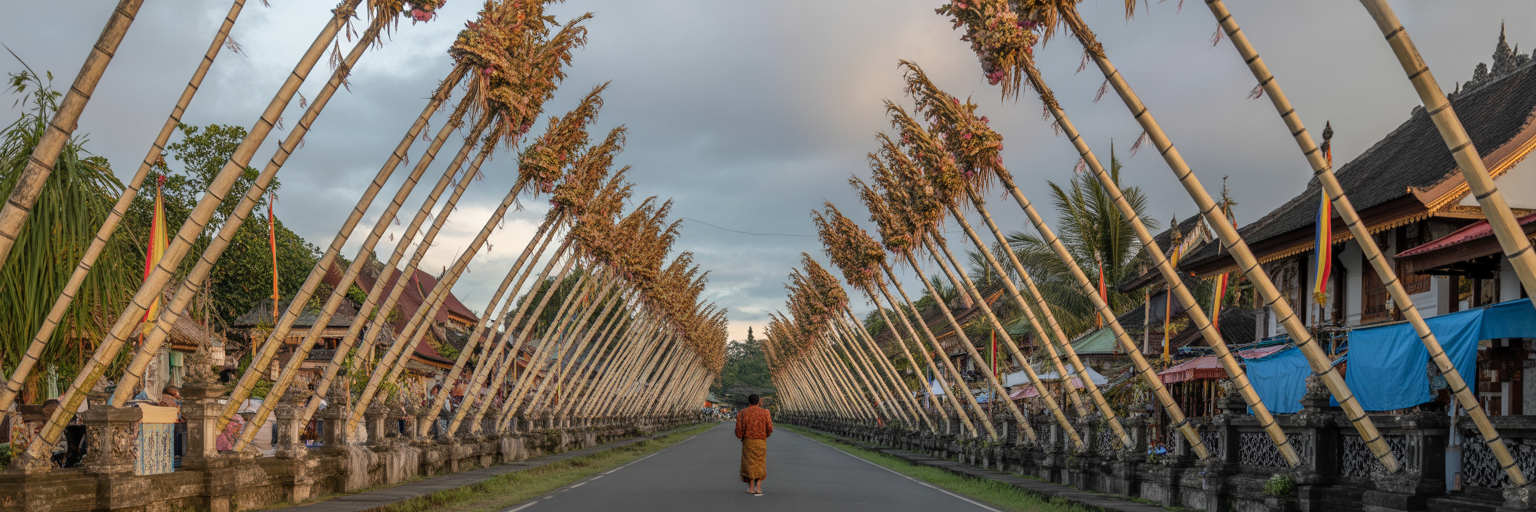
Galungan is a 10-day festival celebrating the victory of dharma (good) over adharma (evil). It is one of the most visually stunning times to be in Bali. The streets are lined with ‘penjor’, towering, decorated bamboo poles that arch over the roads. Families visit temples and make offerings to ancestral spirits who are believed to return to earth during this time. The festival culminates with Kuningan, a day for special prayers and offerings. As a visitor, you can respectfully observe the festive atmosphere and the beautiful decorations that adorn every home and village.
Nyepi: The Day of Silence
Perhaps the most unique festival in Bali is Nyepi, the Hindu New Year, also known as the Day of Silence. For 24 hours, the entire island comes to a complete standstill. The airport closes, no one is allowed on the streets, and all activity ceases. The rules are strict: no fire or light, no working, no entertainment, and no traveling. For a group, this requires preparation. Stock up on food and water, and inform everyone of the rules. While it may sound restrictive, experiencing Nyepi is a rare opportunity for collective reflection and to witness a culture’s commitment to a shared spiritual practice. The night before, however, is anything but quiet, with massive ‘Ogoh-ogoh’ parades where giant demonic effigies are paraded through the streets before being burned.
Odalan: The Vibrant Temple Anniversaries
Every temple in Bali has an anniversary celebration, or Odalan, which occurs every 210 days according to the Balinese calendar. This means that on any given day, there is likely an Odalan happening somewhere on the island. These are vibrant, community-focused events where the temple is beautifully decorated, and villagers come dressed in their finest traditional attire to pray and make offerings. If your group comes across an Odalan, you are welcome to observe from a respectful distance, provided you are properly dressed in a sarong and sash.
Ngaben: A Celebration of Liberation
A Balinese cremation ceremony, or Ngaben, is not a somber affair but a joyous celebration. It is seen as the final and most important duty of the living to liberate the soul of the deceased so it can ascend to the heavens and be reincarnated. These ceremonies can be elaborate and public, involving towering funeral pyres and long processions. If you have the opportunity to witness one, it is a profound cultural experience. However, it is crucial to be an unobtrusive observer. Keep your distance, dress modestly, and never get in the way of the procession. Remember, while it is a celebration, it is also a sacred family ritual. Understanding such local traditions is key to truly experiencing any destination, a principle that guides us in creating all our detailed city guides.
Practical Planning for Your Group’s Cultural Journey
A successful group trip to Bali is built on a foundation of thoughtful planning. The goal is not to schedule every minute but to create a framework that allows for both deep cultural immersion and spontaneous discovery. Here are a few final tips to ensure your group’s journey is as smooth as it is enriching.
- Hire a Local Guide and Private Driver: This is arguably the single best investment for a group. A private driver simplifies logistics, eliminating the stress of navigating traffic or coordinating multiple taxis. A knowledgeable local guide, however, is what transforms the trip. They provide context, answer questions, handle logistics like temple tickets, and act as a cultural bridge, facilitating respectful interactions and sharing insights you would never find in a guidebook.
- Create a Balanced Itinerary: It is tempting to pack your days, but this often leads to burnout. The best Bali cultural experiences for groups are balanced with downtime. Mix temple visits and workshops with relaxing afternoons by the pool or leisurely walks through rice paddies. A balanced itinerary caters to the different energy levels and interests within your group, ensuring everyone stays engaged and refreshed.
- Travel with Curiosity and Humility: The most important thing to pack is the right mindset. Approach Bali with genuine curiosity, an open heart, and a deep sense of humility. Be prepared to have your assumptions challenged. Ask questions, listen to the answers, and be present in the moment.
Let Bali’s unique spiritual warmth wash over your group. Look beyond the surface, and you will find a culture that values community, harmony, and gratitude above all else. These are the lessons that will stay with you long after you have returned home, creating a lasting, shared memory that is the true souvenir of your journey. For more travel inspiration and detailed planning resources, feel free to explore our other guides to various destinations.