The New Philosophy of Youth Travel
The 18th-century Grand Tour was once the pinnacle of education for young elites, a structured journey through classical sites meant to build cultural capital. Today, that spirit of immersive learning has been reinvented, but the currency has changed. It is no longer about what you have seen, but what you have understood. The modern journey is less a checklist of monuments and more a quest for personal transformation.
This shift defines the new era of young adult adventure travel. It moves away from the passive consumption of sights, where cities become backdrops for social media posts. Instead, it champions a mindset of active participation. We all know the feeling of returning from a trip with a camera full of photos but a memory that feels strangely thin. The goal now is to reverse that, to collect experiences that reshape our perspective long after we have returned home.
What does this look like in practice? It means choosing the neighbourhood bakery over the famous tourist cafe, not because it is cheaper, but because you can watch the morning rhythm of a community unfold. Adventure is redefined. It is not just about scaling a mountain; it is about successfully navigating an unfamiliar subway system, ordering a meal without a common language, or understanding the subtle social cues in a conversation. These small victories build a quiet confidence that packaged tours can never offer.
According to a guide by CoraTravels, destinations that enable travellers to connect with the daily life and traditions of a place are becoming highly favoured for more meaningful trips. This points to a growing desire for genuine connection. The search for authentic travel experiences 2026 is driven by this hunger for substance. It is about finding the texture of a place, the things that do not make it into the guidebooks.
Interestingly, technology plays a paradoxical role in this pursuit. We use sophisticated apps and digital maps to find places where we can disconnect. We scroll through blogs to discover the most “unplugged” experiences. This is not a contradiction but a new skill: using digital tools to access an analogue world. The ultimate aim is to trade the highlight reel for the director’s cut, a journey that is less about the scenery and more about the story you become a part of.
Berlin’s Living History and Counter-Culture
Berlin does not just display its history in museums; it wears it on its streets. The city is a living document of the 20th century, a place where scars have become part of the urban fabric. For the traveller seeking depth, Berlin offers a profound lesson in resilience and reinvention. It is a city that invites you to understand its past not by looking at exhibits behind glass, but by walking its streets and observing its present.
Embracing the ‘Kiez’ Culture
To understand Berlin, you must first understand the Kiez. This is not just a neighbourhood; it is a micro-community with its own distinct identity, rhythm, and social rules. Your experience of the city will be completely different depending on whether you are in the leafy, stroller-filled streets of Prenzlauer Berg or the gritty, artistic hub of Neukölln. The former feels like a settled, gentrified vision of urban life, while the latter buzzes with a raw, creative energy. Exploring a Kiez is about finding a favourite cafe, observing the regulars, and learning the unwritten rules of the local park. It is an exercise in becoming a temporary local.
The Adventure of a Cash-Based Economy
Many visitors are surprised to find that Berlin still runs on cash. That corner bar, the flea market stall, even some popular restaurants might not accept cards. Instead of viewing this as an inconvenience, consider it a cultural practice. Using cash forces a different kind of mindfulness. It makes you more aware of your spending and encourages interaction. The act of paying with coins and notes, of planning ahead, slows down the pace of consumption. It is a small but tangible way to step out of the frictionless digital economy and into a more deliberate, analogue rhythm.
A City Shaped by Scars and Stories
The most powerful historical markers in Berlin are often found where you least expect them. Tempelhofer Feld, the former airport, is now a vast public park where people fly kites and cycle on old runways. It is a powerful symbol of freedom reclaimed from a site of immense historical weight. The East Side Gallery is not just a collection of murals but a mile-long remnant of the Wall, a canvas for political expression. Perhaps most poignant are the Stolpersteine, or “stumbling stones.” These small brass plaques are embedded in the pavement outside the last chosen homes of victims of the Holocaust. You stumble upon them in the middle of a normal day, a sudden, personal reminder of the lives that were lived on that very spot. This is how you find an off the beaten path Berlin, by looking down at your feet.
The Unspoken Rules of Social Etiquette
Navigating Berlin’s social landscape is its own adventure. Here are a few cultural immersion travel tips to keep in mind. Berliners are known for their directness, which can be mistaken for rudeness. It is not personal; it is efficient. On public transport, silence is golden. Loud conversations are a quick way to mark yourself as a visitor. Finally, the city’s famous nightlife is notoriously private. The best clubs have strict door policies that are not about what you wear, but about the vibe you bring. The key is to be relaxed, respectful, and to understand that you are entering a space with its own established culture.
Tokyo’s Hyper-Localism and Harmonious Contradictions
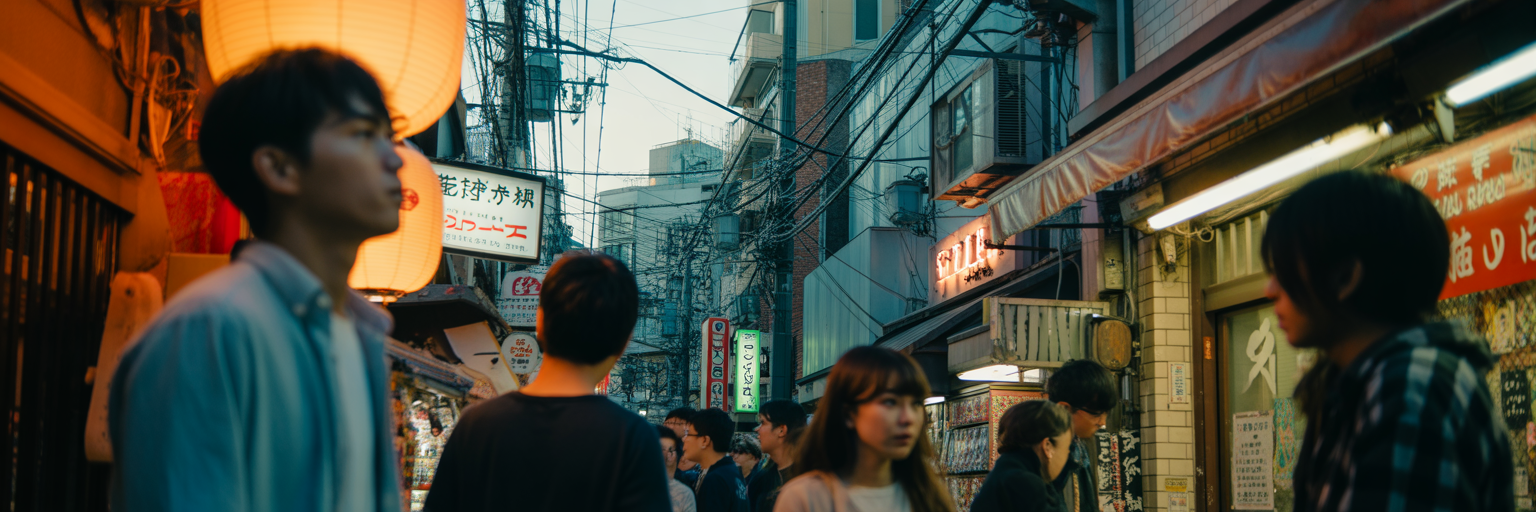
Tokyo presents a different kind of challenge. It is a city of harmonious contradictions, where ancient rituals coexist peacefully with futuristic technology. A thousand-year-old shrine can be found nestled between skyscrapers, and a silent, meditative tea ceremony can take place just floors above a chaotic, neon-lit arcade. The adventure here is not in deciphering a difficult past, but in learning to read the subtle, unspoken rules that govern a complex and deeply layered society.
Beyond Shibuya Crossing: Mastering the Art of the District
The first mistake visitors make is treating Tokyo as a single, monolithic entity. In reality, it is a sprawling collection of distinct villages, each with its own soul. Mastering the unique character of each ward, from Shimokitazawa’s vintage finds to Yanaka’s old-world charm, is the key to truly understanding the city’s structure. This approach of deep-diving into neighbourhoods is essential for any immersive journey, and you can find more inspiration in various city guides we have curated. A proper Tokyo local neighborhoods guide would show you that Koenji is the heart of the punk music scene, while Daikanyama offers chic boutiques and quiet cafes. Spending a day in one of these districts, rather than rushing between landmarks, allows the city’s true character to reveal itself.
The Ritual of Food and Drink
In Tokyo, eating and drinking are rarely just about consumption; they are about ritual. Step into a standing ramen bar and you will notice a focused, almost reverent silence as patrons give their full attention to the bowl in front of them. This is not antisocial; it is a sign of respect for the chef’s craft. A kissaten, a traditional coffee shop, is a quiet retreat from the city’s pace, a place for contemplation over a carefully prepared cup. In contrast, an izakaya (a Japanese pub) is loud and communal, a space for colleagues and friends to unwind. Understanding the expected atmosphere in each of these settings is as important as knowing what to order.
Finding Serenity Amidst the Chaos
How do you find peace in one of the world’s most densely populated cities? Tokyo offers countless lessons in finding stillness. It might be the unexpected quiet of a small neighbourhood shrine, tucked away on a side street, offering a moment of reflection. It could be the unspoken rule of silence on trains, where an entire carriage of people moves through the city in a state of collective calm. Serenity is not found by escaping the city, but by learning to find the pockets of tranquility that exist within it. This practice of seeking out quiet moments trains your attention and attunes you to the city’s more subtle rhythms.
Navigating a Society of Implicit Communication
The ultimate challenge for the immersive traveller in Tokyo is learning to navigate a society that relies heavily on implicit communication. The Japanese concept of kuki wo yomu, or “reading the air,” is central to social interaction. It is the ability to sense the mood of a situation and understand what is not being said. This is a culture where harmony is prized, and direct confrontation is avoided. Learning to interpret non-verbal cues, to understand the meaning of a pause, and to appreciate the importance of group consensus is the final frontier of cultural immersion. It is a skill that requires patience and observation, but the reward is a much deeper and more meaningful connection to the people around you.
Istanbul’s Crossroads of Continents and Cultures
Istanbul is a city built on dualities. It is the only metropolis in the world that straddles two continents, but its identity as a crossroads runs much deeper. It is a place where ancient traditions meet modern aspirations, where the sacred and the secular share the same skyline, and where the energy of Europe blends with the soul of Asia. The adventure in Istanbul is learning to live within this constant, beautiful interplay of contrasting forces.
Living on Two Continents as a Daily Commute
The Bosphorus Strait is not just a tourist attraction; it is a vital artery of daily life. To understand the city’s rhythm, skip the tourist cruise and use the public ferry as a local commuter does. Take a boat from the bustling, historic hub of Eminönü on the European side to the relaxed, residential neighbourhood of Kadıköy on the Asian side. You will feel the city’s energy shift. The journey itself, with vendors selling tea and simit (sesame bread rings) on board, offers a glimpse into the daily flow of Istanbul’s residents. It transforms a geographical curiosity into a lived experience.
The Culture of Conversation and Commerce
While the Grand Bazaar is an essential experience, the true culture of commerce in Istanbul is found in its neighbourhood markets, or pazars. Here, shopping is a social activity. But the most important cultural concept to grasp is misafirperverlik, or hospitality. It is a cornerstone of Turkish culture. Do not be surprised if a shopkeeper offers you a glass of tea with no expectation of a sale. This is an invitation to conversation. Accepting it is a sign of respect and an opportunity to connect. The transaction is secondary to the human interaction.
A Culinary Journey Through Anatolian History
To eat authentically in Istanbul, you must seek out an esnaf lokantası. These are “tradesmen’s restaurants,” humble eateries that serve traditional, home-style Anatolian dishes. Often operating with a cafeteria-style counter, they offer a rotating menu of stews, vegetable dishes, and grilled meats that reflect the diverse culinary heritage of the region. Eating at an esnaf lokantası is not just a meal; it is a taste of history, a direct connection to the food that has sustained the city’s working class for generations. It is a world away from the tourist-focused kebab shops of Sultanahmet.
Respectful Navigation of Tradition and Modernity
Understanding what to know before visiting Istanbul is key to a respectful journey. This means being mindful of the city’s religious rhythm. The call to prayer, broadcast from minarets five times a day, is a beautiful and integral part of the city’s soundscape. When visiting mosques, dress modestly, with shoulders and knees covered, and women should carry a scarf for their hair. If your visit coincides with Ramadan, be mindful that many locals will be fasting during the day. Showing sensitivity to these traditions is not just polite; it is a fundamental part of experiencing the city’s deep cultural identity.
| Activity | Standard Tourist Approach | Immersive Local Approach | Cultural Insight Gained |
|---|---|---|---|
| Crossing the Bosphorus | Paid tourist cruise with commentary | Using the public ferry from Eminönü to Kadıköy | Understanding the city’s daily commute and continental divide |
| Shopping for Souvenirs | Browsing the Grand Bazaar or Spice Bazaar | Visiting a weekly neighborhood ‘pazar’ (market) | Observing local commerce and social interaction |
| Eating a Meal | Finding a restaurant in the main Sultanahmet square | Eating at an ‘esnaf lokantası’ (tradesmen’s restaurant) in Beyoğlu or Fatih | Tasting authentic, regional home-style cooking |
| Drinking Coffee | Ordering a ‘Turkish coffee’ at a tourist cafe | Participating in the ritual at a historic coffeehouse and having your fortune told | Appreciating coffee as a social and cultural tradition |
| Experiencing History | Touring the Topkapi Palace and Hagia Sophia | Wandering the backstreets of Balat and Fener to see historic homes | Seeing how history is lived in, not just preserved in museums |
This table illustrates how shifting from conventional tourist activities to local-oriented experiences can provide a deeper and more authentic understanding of Istanbul’s culture and daily life.
The Universal Toolkit for Immersive Travel

The lessons learned in Berlin, Tokyo, and Istanbul are not unique to those cities. They are part of a universal framework for immersive travel that you can apply anywhere in the world. It is a mindset of curiosity and a toolkit of observational techniques that transform you from a passive tourist into an active participant. This approach is central to the philosophy of When In Your City.
A great starting point is the Public Transit Litmus Test. If you can confidently navigate a city’s bus, tram, or subway system, you have already taken the first step toward understanding its geography and social structure. You see how neighbourhoods connect, where people work, and where they live. It is a practical skill that immediately grounds you in the reality of a place.
Next, seek out a “third place.” This is a sociological concept for the spaces we inhabit outside of home and work, like cafes, parks, and libraries. Finding a third place while travelling gives you a window into the everyday life of a community. Sit on a park bench for an hour and just watch. Go to a local library and see what people are reading. These spaces are where the unscripted life of a city happens.
To turn passive sightseeing into active engagement, try these techniques for mindful observation:
- Spend one hour in a public square or park without your phone. Journal the sounds, smells, and interactions you notice.
- Create a personal photo essay with a specific theme, like ‘doorways,’ ‘window displays,’ or ‘street fashion’ in a particular neighbourhood.
- Attempt to navigate from one point to another using only a physical map, forcing you to pay attention to street names and landmarks.
- Visit the same neighbourhood cafe at the same time for three days in a row. Observe the regulars and the rhythm of the place.
- Trace a single product at a local market back to its origin. Ask the vendor about it and learn its story.
For digital nomads, this approach is especially important. It is easy to fall into an expat bubble, moving between co-working spaces and international cafes. The goal should be to become a temporary resident, not a long-term tourist. Join a local sports club, take a language class, or volunteer for a community project. These actions create genuine connections and integrate you into the social fabric of your temporary home. This mindset of being a temporary resident, not a tourist, is a universal principle. The same curiosity that leads you to a hidden ‘izakaya’ in Tokyo can help you understand the local culture anywhere, even when you’re getting to know the real Bryan, Texas.
Crafting Your Own Authentic Journey
Ultimately, the most transformative journeys are the ones you design yourself. The destinations we have explored are not just places on a map; they are examples of a philosophy in action. The real adventure is found in cultural navigation, not just in physical exploration. Authenticity is not a location you can book, but a mindset of curiosity you must cultivate.
Embrace flexibility. Some of the most memorable travel moments happen when you abandon the itinerary. That wrong turn that leads you to a beautiful hidden courtyard, the conversation with a stranger that changes your perspective, the rainy afternoon spent in a small museum you had never heard of. These are the moments that cannot be planned, only allowed to happen.
The goal is to return home with a souvenir that cannot be packed in a suitcase: a changed perspective. It is a deeper empathy for other ways of life and a more nuanced understanding of the world. The journey’s true value is its lasting impact on who you are. The goal is to return home with a changed perspective, ready to apply that same curiosity to the world around you, and perhaps, to start planning the next journey. For those ready to take that next step, our city guides offer a starting point for crafting your own authentic adventure.